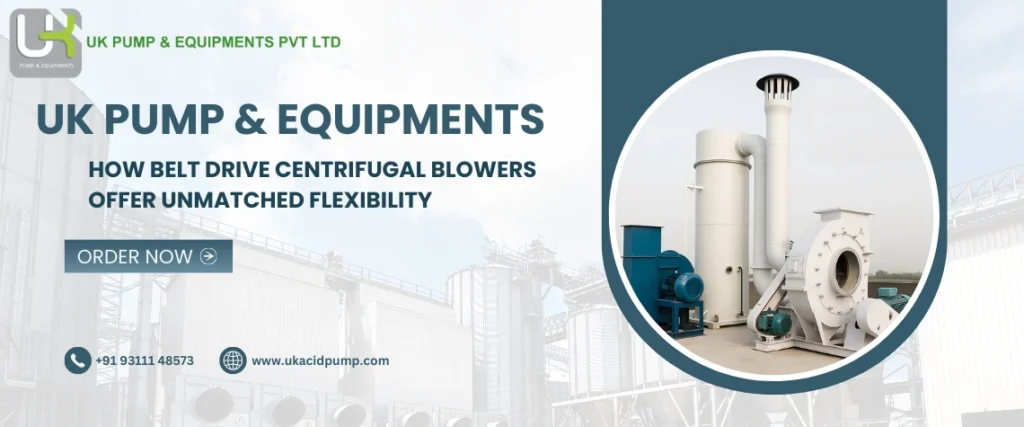
Belt Drive Centrifugal Blowers
In industrial air and gas movement, system demands are rarely static. Processes change, production scales, and operational requirements evolve. This dynamic landscape demands equipment that can adapt. Belt Drive Centrifugal Blowers provide this essential versatility. They stand as a pinnacle of adjustable and reliable air technology. Their unique design delivers performance where it is needed most. Leading Centrifugal Blower Manufacturers consistently recommend them for complex applications. This exploration reveals the core reasons for their unparalleled flexibility.
The Core Mechanism: Understanding the Belt Drive Advantage
The fundamental design of these blowers enables their adaptability. Unlike direct-drive models, a belt and pulley system separates the motor from the impeller.
Decoupling Speed for Precise Control
In a belt drive system, the motor and the blower fan operate independently. This is the heart of their flexibility. The motor shaft spins at a constant speed. However, the impeller’s speed can be changed easily. Technicians achieve this by simply adjusting the pulley sizes. This creates a precise mechanical advantage.
The Simple Science of Pulley Ratios
The ratio between the motor pulley and the fan pulley dictates the final fan speed. A larger fan pulley reduces the impeller’s rotational speed. Conversely, a smaller fan pulley increases it. This straightforward principle allows for significant performance tuning. Operators can fine-tune airflow and pressure without altering the motor itself.
Operational Flexibility: Adapting to Real-World Demands
This adjustable speed mechanism translates into powerful on-the-ground benefits. Facilities can respond to changes without major capital investment.
Effortless Performance Tuning
A process may require a higher static pressure in the future. Perhaps a new duct run adds system resistance. With a Belt Drive Centrifugal Blower, adaptation is simple. Engineers can calculate the new required fan speed. Then, they install a different pulley pair to achieve it. This process is far simpler and cheaper than replacing an entire blower unit.
One Blower, Multiple Duty Points
Different production cycles might need different air volumes. For example, a ventilation system may have summer and winter settings. Belt drive blowers can accommodate these variable duty points. This adaptability makes them ideal for applications with seasonal or batch-process fluctuations. Their versatility often eliminates the need for costly variable frequency drives (VFDs) on smaller systems.
Maintenance and Serviceability: Flexibility in Upkeep
Ease of maintenance is a critical form of operational flexibility. Belt drive systems excel in serviceability, reducing downtime significantly.
Simplified Component Access and Replacement
The belt drive compartment is inherently accessible. During routine maintenance, technicians can easily reach key components. They can inspect, tension, or replace belts without major disassembly. Furthermore, they can service bearings and shafts independently of the motor. This modular approach keeps maintenance windows short and predictable.
The Economic Advantage of Common Parts
Belts and standard pulley sizes are common industrial items. They are readily available from multiple suppliers at competitive prices. This contrasts with proprietary direct-drive motor components. Sourcing common parts prevents lengthy downtime. It also gives plant managers purchasing flexibility and cost control for spare parts inventory.
Application Versatility Across Industries
The flexibility of Belt Drive Centrifugal Blowers makes them suitable for a vast range of applications. They are not confined to a single niche.
A Staple in Air Pollution Control
These blowers are vital in scrubbers and fume extraction systems. Process changes can alter the ductwork resistance profile. The ability to adjust fan speed ensures the system always meets capture velocity requirements. Centrifugal Blower Manufacturers often specify belt drives for this very reason. They provide a future-proof solution for evolving environmental controls.
Critical Roles in Material Handling and Processing
In pneumatic conveying, product density or feed rate may change. A belt drive blower can be retuned to maintain optimal line velocity. Similarly, in combustion air supply, fuel switches or burner upgrades may demand different air volumes. The blower can adapt to these new parameters seamlessly, protecting the core process investment.
Financial and Energy Efficiency Flexibility
The adaptability of these systems directly impacts the bottom line. They offer financial flexibility through both capital and operational savings.
Optimizing for Peak Efficiency
Every blower has a peak efficiency point at a specific pressure and flow. A belt drive system allows operators to “dial in” this point. They can adjust the pulley ratio to match the blower’s best efficiency to the actual system demand. This precise matching reduces wasted energy, lowering operating costs daily.
Deferring and Reducing Capital Expenditure
Designing a system for future capacity? Install a Belt Drive Centrifugal Blower sized for the future need. Initially, run it at a lower speed with smaller pulleys. When production expands, simply upgrade the pulleys to unlock full capacity. This strategy staggers capital outlay and aligns spending with actual growth.
The Strategic Choice for System Designers
For engineers and plant designers, this flexibility simplifies the specification process. It reduces risk and builds resilience into air systems.
Mitigating Design and Calculation Risk
System pressure loss calculations are estimates. Actual installed systems often have different resistance. A belt drive blower provides a built-in adjustment factor. If the system performs differently than modeled, engineers can tweak the fan speed. This corrects the performance without blaming the initial design or requiring ductwork modifications.
Ensuring Long-Term System Relevance
Industrial processes are guaranteed to change over a 15-year blower life. A belt drive model accommodates this inevitable evolution. It extends the usable life of the capital asset. This makes it a sustainable and strategic choice. Forward-thinking Centrifugal Blower Manufacturers highlight this as a key long-term value proposition.
Conclusion: Embracing Adaptive Power for Lasting Performance
In conclusion, the flexibility of Belt Drive Centrifugal Blowers is not a minor feature. It is their defining characteristic and greatest strength. They provide mechanical simplicity, operational adaptability, and financial savvy. From easy speed changes to straightforward maintenance, they empower facilities to control their air systems.
When selecting equipment, consider future needs alongside current ones. Choose the technology that embraces change rather than resisting it. Partner with experienced Centrifugal Blower Manufacturers who understand this principle. They can help specify the correct Belt Drive Blower for both today’s duty and tomorrow’s challenge. Ultimately, this flexibility translates into reliability, efficiency, and peace of mind for years to come. Choose adaptability. Choose the unmatched flexibility of a belt drive centrifugal blower system.