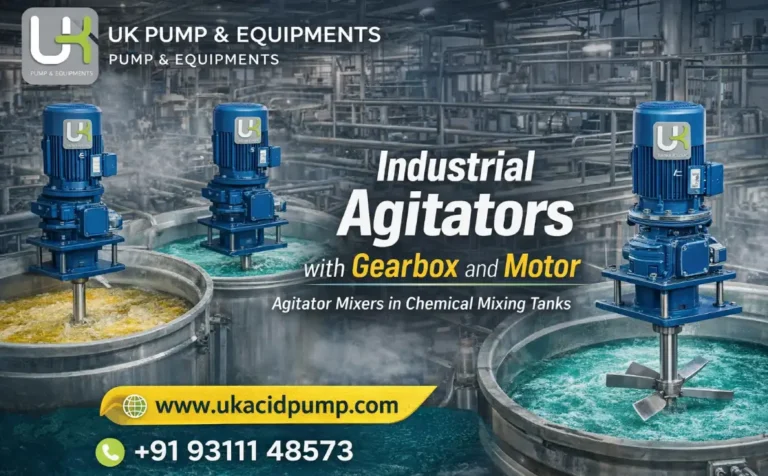
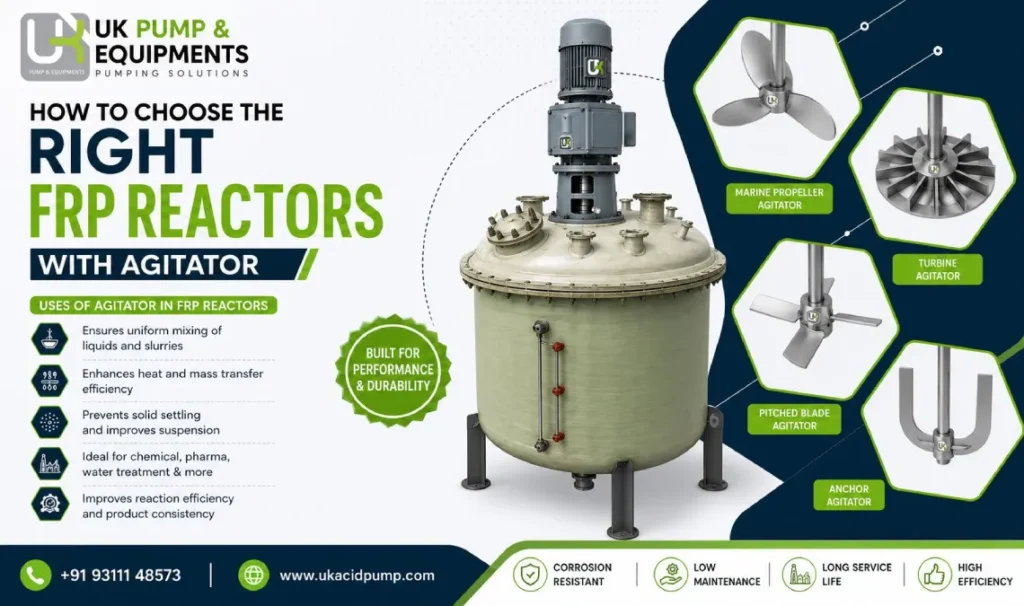
Selecting the correct FRP Reactor With Agitator is vital for chemical processing success. This equipment handles corrosive fluids, high temperatures, and intense mixing duties. A poor choice leads to failures, leaks, or costly downtime. Therefore, you need a systematic selection approach. This guide explains every critical factor. You will learn about materials, design, agitation, and manufacturers. Welcome to UK PUMP & EQUIPMENTS. We stand as one of the most trusted industrial Agitator Manufacturers in the industrial landscape. Use this roadmap to make an informed decision.
Understand FRP Material Properties
Fiber Reinforced Plastic (FRP) offers unique benefits. First, it resists corrosion exceptionally well. Second, it is lightweight compared to steel. Third, FRP reduces installation costs. However, not all FRP grades perform equally. You must check the resin type. For example, vinyl ester resin handles acids better. On the other hand, isophthalic polyester suits alkaline media. Additionally, the glass fiber content affects strength. Aim for 30% to 40% fiber by weight. This range provides optimal mechanical properties. Also, consider the inner surface layer. It should be a corrosion barrier. Typically, this layer uses a resin-rich veil mat. Finally, verify the manufacturer’s testing data. Tensile strength should exceed 100 MPa. Flexural modulus must stay above 6 GPa. These numbers ensure long-term reliability.
Define Your Process Parameters
Every application has unique demands. Thus, start by listing all process conditions. First, identify the chemicals involved. Organic solvents, strong acids, or caustic solutions each require different FRP grades. Second, note the operating temperature. Standard FRP works from -10°C to 100°C. For higher temperatures, use specialty resins. Third, specify the pressure rating. Most reactors operate at atmospheric or low pressure. But some need up to 5 bar. Fourth, calculate the batch size. This determines the reactor volume. Common sizes range from 500 liters to 20,000 liters. Fifth, consider cleaning requirements. Frequent cleaning demands smooth internal surfaces. Finally, define the mixing goal. Do you need suspension, dispersion, or heat transfer? Each goal influences agitator design.
Choose the Right Agitator Type
The agitator is the heart of your FRP Reactor With Agitator. Different impellers produce different flow patterns. Therefore, match the agitator type to your process.
Axial Flow Impellers
These move fluid parallel to the shaft. Use them for solid suspension or blending. Examples include marine propellers and pitched blade turbines. They work well for low to medium viscosity fluids. Additionally, they create gentle mixing. This prevents shear damage to sensitive products.
Radial Flow Impellers
These push fluid outward toward the vessel wall. Use them for gas dispersion or heat transfer. Rushton turbines are common radial designs. They produce high shear. Consequently, they suit emulsification and particle size reduction.
Mixed Flow Impellers
These combine axial and radial characteristics. They are versatile for many reactions. Hydrofoil impellers fall into this category. They offer high efficiency with low power consumption. Moreover, they reduce vortex formation.
Anchor and Helical Ribbon Agitators
Use these for high viscosity fluids above 10,000 cP. Anchor agitators scrape the vessel wall. This prevents sticking and improves heat transfer. Helical ribbons create top-to-bottom flow. They work well for pastes and thick slurries.
Select Motor and Drive Specifications
The motor powers the agitation system. Consequently, you must calculate required torque and speed. First, determine the viscosity of your mixture. Low viscosity fluids (1 to 500 cP) need low torque. High viscosity fluids (above 10,000 cP) require high torque. Second, consider the impeller diameter. Larger impellers need more power. Third, calculate the power number for your impeller type. For example, a pitched blade turbine has a power number around 1.5. Use this formula: Power = Np × ρ × N³ × D⁵. Here, Np is power number, ρ is density, N is rotational speed, and D is impeller diameter.
Typical motor sizes range from 1 HP to 100 HP. For small reactors, choose a 2 HP motor. For large industrial reactors, go with 30 HP or more. Also, select the right drive type. Belt drives offer speed flexibility. Gear drives provide constant torque. In addition, add a variable frequency drive (VFD). VFDs allow precise speed control. This improves process consistency.
Evaluate Mixing Performance Requirements
Industrial Agitator with FRP Tanks must achieve specific results. Therefore, evaluate these performance metrics.
Blend Time
This measures how quickly contents become uniform. Short blend times are essential for batch reactors. Typically, blend time should be under 5 minutes. Use multiple impellers for faster blending.
Solid Suspension
If your process contains solids, check suspension quality. All particles must remain suspended without settling. The just-suspended speed (Njs) is a key parameter. Operate 10% above Njs for safety.
Gas Dispersion
For reactions involving gases, the agitator must break bubbles. Small bubbles increase mass transfer. Consequently, use a Rushton turbine or similar high-shear impeller. Maintain tip speeds between 3 to 6 m/s.
Heat Transfer
Many reactions need heating or cooling. The agitator promotes heat transfer. It reduces boundary layer resistance. Therefore, choose high-turbulence impellers. Also, consider adding baffles. Baffles prevent swirling and improve mixing.
Understand Vessel Design Features
The reactor vessel itself affects performance. Pay attention to these design elements.
- Aspect Ratio: This is height divided by diameter. Standard ratios are 1:1 or 2:1. Taller vessels (ratio 2:1) need multiple impellers. Shorter vessels (ratio 1:1) work with a single impeller.
- Bottom Shape: Flat bottoms are common for low viscosity. Dish bottoms improve draining. Conical bottoms suit solids discharge. Choose based on your emptying needs.
- Nozzles and Connections: Proper nozzle placement is critical. Locate the inlet nozzle above the agitator. This prevents short-circuiting. Place the outlet at the lowest point. Also, include a manway for inspection. Standard manway diameter is 450 mm.
- Baffles: Baffles convert tangential flow to axial flow. They also eliminate vortexing. Typically, use four baffles at 90-degree intervals. Each baffle width equals 1/10 of the tank diameter. For viscous fluids above 10,000 cP, baffles are unnecessary.
Corrosion Resistance and Lining Options
Corrosion Resistant FRP Reactors are essential for harsh chemicals. Yet, standard FRP may not suffice for all cases. Hence, consider these lining options.
- Thermoplastic Liners: Polypropylene (PP) or polyvinylidene fluoride (PVDF) liners add extra protection. These liners resist strong acids and halogens. For example, PVDF handles hydrochloric acid well. PP resists caustic solutions. The liner thickness typically ranges from 2 mm to 5 mm.
- Dual Laminate Construction: This combines FRP with a thermoplastic inner layer. The FRP provides structural strength. The thermoplastic offers chemical resistance. Dual laminate reactors cost more but last longer. They are ideal for aggressive media like sulfuric acid.
- Surface Veil: A C-glass veil improves corrosion resistance. It creates a resin-rich surface. This surface prevents chemical penetration. Always specify a veil layer for acid service.
Consider Manufacturer Reputation
Working with reputable Agitator Mixer Manufacturers ensures quality. Therefore, evaluate potential suppliers carefully.
- Quality Certifications: Look for ISO 9001:2015 certification. This proves consistent manufacturing processes. Also, check for ASME RTP-1 certification. This applies to reinforced thermoset plastic vessels. Additionally, ask for material test reports. Every batch should include resin and fiber certificates.
- Experience and References: How long has the manufacturer operated? Prefer companies with 10+ years of experience. Request customer references. Contact those references about reliability and after-sales support.
- Customization Capability: Every process is unique. Hence, the manufacturer must offer custom designs. They should adjust nozzle positions, impeller types, and vessel sizes. Moreover, they must provide CAD drawings for approval.
Mechanical Design and Standards
A robust FRP Industrial Agitator Reactor follows recognized standards. Familiarize yourself with these technical requirements.
- ASME RTP-1: This standard covers design, fabrication, and inspection. It defines minimum thickness requirements. For a 3,000-liter reactor, the minimum wall thickness is typically 12 mm. The standard also mandates hydrostatic testing. Each vessel must hold 1.5 times the design pressure without leaking.
- BS 4994: This British standard is common for FRP vessels. It specifies laminate schedules. For example, a corrosion barrier requires 2.5 mm minimum thickness. The structural layer thickness depends on pressure and diameter.
- Nozzle Reinforcement: Nozzles create stress concentrations. Therefore, reinforce each nozzle with additional laminates. The reinforcement area should equal the nozzle cross-section. Use radiused corners to reduce stress.
Installation and Foundation Requirements
Proper installation extends reactor life. Follow these guidelines.
- Support Systems: FRP vessels are less rigid than steel. Consequently, use adequate supports. For vertical reactors, install a skirt support. The skirt distributes weight evenly. Alternatively, use leg supports for smaller units. Ensure the support does not create point loads.
- Foundation Design: The foundation must be level and flat. Concrete foundations work best. Embed anchor bolts according to the manufacturer’s drawing. Use a leveling grout beneath the support. Allow 7 days for grout to cure before filling the reactor.
- Piping Connections: Connect piping with flexible couplings. Rigid connections transfer stress to the nozzle. This can cause cracking. Therefore, use rubber expansion joints. Also, support all pipes independently. Never hang pipe weight from the reactor nozzle.
Maintenance and Inspection Guidelines
Regular maintenance keeps your FRP Reactor With Agitator operating safely. Implement these practices.
- Visual Inspection: Check for surface cracks every month. Use a bright light at a shallow angle. Cracks appear as white lines. Small cracks can be repaired. Large cracks require professional assessment.
- Thickness Measurement: Use an ultrasonic thickness gauge annually. Measure at 10 different points. Compare readings to the original thickness. A 20% reduction indicates deterioration. Plan for replacement or repair.
- Agitator Shaft Alignment: Misalignment causes seal failure and vibration. Check alignment every six months. Use dial indicators for precision. Allowable runout is 0.2 mm per meter of shaft length.
- Seal Maintenance: Mechanical seals wear over time. Inspect seals every 3 months. Look for leakage or scoring. Replace seals when leakage exceeds 10 drops per minute. Single mechanical suits low pressure. Double mechanical seals are for hazardous chemicals.
Safety Features and Compliance
Safety cannot be an afterthought. Therefore, incorporate these features.
- Pressure Relief: Every reactor needs a pressure relief device. Use a rupture disk or pressure relief valve. Set the relief pressure at 10% above maximum operating pressure. Vent the discharge to a safe location.
- Temperature Monitoring: Install a thermowell with a temperature sensor. Connect the sensor to an alarm system. Set alarms at 5°C below the resin degradation temperature.
- Emergency Shutdown: Provide an emergency stop button near the reactor. The button should cut power to the agitator motor. Also, consider a remote shutdown from the control room.
- Grounding: FRP is non-conductive. Therefore, static electricity can build up. Install a grounding lug on the agitator shaft. Connect to a verified ground. This prevents sparking with flammable solvents.
Cost Considerations and ROI
Price should not be your only factor. Instead, calculate total cost of ownership in INR.
- Initial Purchase Price: A 2,000‑liter FRP Chemical Reactor Tank costs between ₹6,50,000 and ₹20,00,000. Prices vary by complexity. Custom designs increase cost by 20% to 40%. Smaller units (500 liters) start near ₹3,00,000. Large reactors (10,000 liters) can exceed ₹35,00,000.
- Installation Cost: Foundation and piping add 15% to 25% of equipment cost. For a ₹10,00,000 reactor, installation adds ₹1,50,000 to ₹2,50,000. Professional installation is mandatory. DIY installation voids warranties.
- Operating Cost: Power consumption is a major expense. A 15 HP motor running 8 hours daily costs about ₹1,50,000 annually (assuming ₹8 per kWh). VFDs reduce power use by 20%. Also, consider replacement impellers. Stainless steel impellers last 5+ years. FRP-coated impellers last 2 to 3 years. A new impeller costs ₹25,000 to ₹1,00,000.
- Maintenance Cost: Annual maintenance is 3% to 5% of purchase price. For a ₹10,00,000 reactor, budget ₹30,000 to ₹50,000 per year. This includes seals, gaskets, and inspections. Predictive maintenance reduces unscheduled downtime. A mechanical seal replacement costs ₹8,000 to ₹25,000.
- Lifespan: Properly maintained FRP reactors last 15 to 20 years. In corrosive service, expect 10 to 12 years. Compare this to stainless steel, which may last 25 years but costs 3 to 4 times more (₹20,00,000 to ₹40,00,000 for a 2,000‑liter unit).
Return on Investment (ROI) Example: Assume you buy a 2,000‑liter FRP Reactor With Agitator for ₹10,00,000. It replaces a failing mild steel reactor. The new reactor reduces chemical loss by 5% annually. That saves ₹2,00,000 per year. It also reduces maintenance downtime by 30 hours per year. Each hour of downtime costs ₹5,000 in lost production. That saves another ₹1,50,000. Total annual saving: ₹3,50,000. Simple payback period = ₹10,00,000 ÷ ₹3,50,000 ≈ 2.9 years. After payback, the reactor delivers pure profit for 12+ more years.
Application-Specific Recommendations
Different industries have unique needs. Use these tailored suggestions.
- Pharmaceutical Reactors: Require ultra-smooth internal finishes. Surface roughness must be below 0.8 microns. Choose electropolished agitators. Also, use sanitary clamps instead of threaded connections.
- Fertilizer Production: Handles phosphoric acid and ammonia salts. Use vinyl ester resin with a C-glass veil. Add a PP liner for extra safety. Install an anchor agitator to prevent salt buildup.
- Paints and Coatings: Need high shear for pigment dispersion. Use a cowles blade or saw-tooth impeller. Operate at tip speeds above 10 m/s. The vessel should have a conical bottom for complete draining.
- Wastewater Treatment: Handles abrasive slurries. Therefore, use a rubber-lined agitator. The FRP vessel should have extra thickness (15 mm minimum). Choose a low-speed agitator to reduce erosion.
Future-Proofing Your Investment
Technology evolves rapidly. Thus, plan for future changes.
- Modular Design: Select a reactor with interchangeable agitators. This allows process modifications. For example, start with a hydrofoil. Later, switch to a Rushton turbine. Modular flanges make this easy.
- Data Logging: Integrate sensors for continuous monitoring. Track temperature, vibration, and power draw. Use this data for predictive maintenance. Also, comply with Industry 4.0 standards.
- Expansion Capability: Choose a reactor with spare nozzles. Blank off these nozzles for future use. This avoids drilling holes later. Drilling damages FRP laminates.
Final Checklist Before Purchase
Before placing your order, verify these items.
Process conditions (chemicals, temperature, pressure) are fully defined.
Impeller type matches your mixing goal (suspension, dispersion, heat transfer).
Motor power includes a 20% safety margin.
Manufacturer holds ISO 9001 and ASME RTP-1 certifications.
Vessel design complies with applicable standards.
Corrosion barrier is appropriate for your chemicals.
Baffles are included for low-viscosity fluids.
Nozzle sizes and positions match your piping.
Foundation design is approved by a civil engineer.
Maintenance access allows seal and impeller removal.
Price includes delivery and installation support.
Warranty covers at least 12 months against defects.
Conclusion
Selecting the right FRP Reactor With Agitator demands careful analysis. Evaluate your process thoroughly. Match the agitator design to your fluid properties. Verify manufacturer credentials without compromise. Include all necessary safety features. Finally, plan for long-term maintenance. This approach delivers decades of reliable service. Contact UK PUMP & EQUIPMENTS today for expert guidance. We provide customized Industrial Mixing Reactor Tanks for every application. Our team ensures your reactor meets exact specifications. Achieve superior mixing results with our proven solutions.
Frequently Asked Questions
Yes, but you need a vinyl ester resin with a C-glass veil. For frequent switching, add a thermoplastic liner to prevent cross-contamination and chemical attack.
Use Power = Np × ρ × N³ × D⁵. Then divide by 746 to get HP. Add 20% safety margin. Our engineers provide free calculations for your process data.
Standard reactors take 4 to 6 weeks. Custom designs with dual laminate or special agitators require 8 to 10 weeks. Rush orders possible at extra cost.
Yes, we offer field lining services. The steel surface is sandblasted, then we apply multiple FRP layers. Total thickness 6 to 12 mm. Work takes 5 to 7 days.
Yes, we serve all major industrial hubs. Our team handles foundation, piping alignment, agitator setup, and trial runs. Warranty starts after successful commissioning.