Top Entry Industrial Agitators play a vital role in chemical, pharmaceutical, and process industries. These machines mix, blend, and homogenize liquids inside tanks and reactors every single day. However, like any mechanical equipment, they face wear and operational stress over time. Understanding these issues helps plant operators maintain smooth production without costly downtime. This blog explores the most common problems in Top Entry Industrial Agitators and offers practical, field-tested solutions to keep your mixing systems running efficiently.
Why Top Entry Industrial Agitators Matter in Industrial Processing
Industries rely heavily on reliable Chemical Mixing Equipment for consistent product quality. Top entry agitators, mounted vertically on tank tops, provide strong mixing action for viscous and low-viscosity fluids alike. They are widely used alongside FRP Reactor With Agitators setups, especially where corrosive chemicals are involved. Because these systems operate almost continuously, mechanical stress naturally builds up. Therefore, identifying early warning signs becomes essential for every plant manager who wants uninterrupted production.
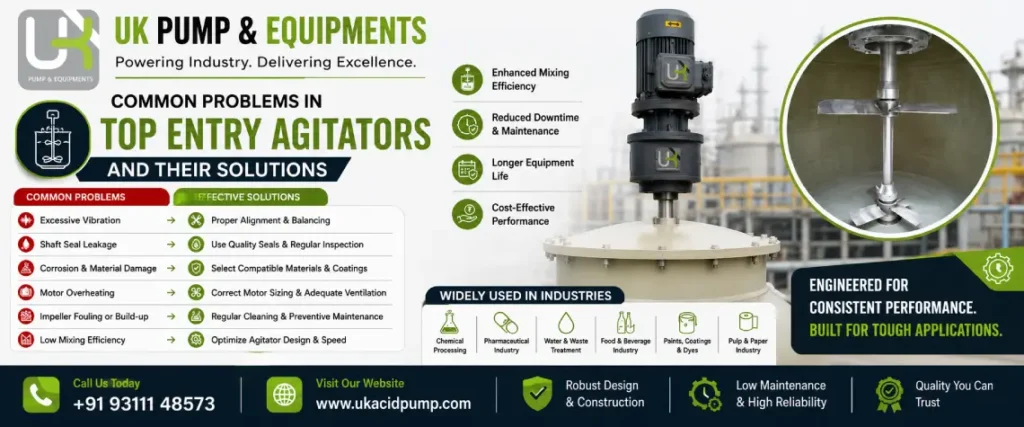
Common Problems in Top Entry Industrial Agitators
Most operators eventually face a handful of recurring issues. Below, we break down each problem and explain why it happens.
1. Shaft Misalignment and Vibration
Shaft misalignment ranks among the most frequent issues in vertical mixing systems. When the shaft bends or shifts from its original axis, excessive vibration usually follows. As a result, bearings wear out faster, and seals may start leaking.
Causes of Misalignment
- Improper installation during commissioning
- Loose foundation bolts over time
- Long, unsupported shaft length
Impact on Performance
Vibration reduces mixing efficiency significantly. Additionally, it increases noise levels and shortens the overall equipment life.
Solution: Regular alignment checks, along with vibration monitoring sensors, help detect problems early. A qualified Top Entry Agitator Manufacturer can also recommend proper shaft support based on tank depth and fluid viscosity.
2. Seal and Bearing Failures
Seals and bearings often fail due to chemical exposure or inadequate lubrication. Consequently, leakage occurs, which can contaminate the product or harm the surrounding environment.
Common Triggers
- Corrosive media contact
- Poor lubrication schedule
- Excessive axial load
Solution: Choosing mechanical seals rated for your specific chemical environment prevents premature failure. Moreover, scheduling routine lubrication extends bearing life considerably and reduces unplanned stoppages.
3. Motor Overheating
Motors overheat when they run beyond their rated capacity or when cooling airflow gets blocked. This problem is fairly common in Industrial Agitators with Gearbox and Motor configurations operating inside enclosed spaces.
Solution: Ensure proper ventilation around the motor housing at all times. In addition, monitor load current regularly to avoid overloading the drive. Installing thermal protection relays adds another useful safety layer.
4. Gearbox Wear and Noise
Gearboxes experience gradual wear from continuous torque transmission. Unusual noise or a grinding sound usually indicates internal gear damage.
Solution: Scheduled oil changes and periodic gear inspections reduce wear significantly. Furthermore, sourcing gearboxes designed specifically for Top Entry Industrial Agitators ensures better torque handling and long-term durability.
5. Inefficient Mixing Performance
Sometimes, agitators fail to achieve the desired blend quality despite running normally. This issue often stems from incorrect impeller selection or the wrong mounting height.
Solution: Consulting an experienced Top Entry Agitator Supplier helps match impeller design with your actual process requirements. Similarly, adjusting impeller clearance from the tank bottom improves flow patterns considerably.
6. Corrosion in Chemical Mixing Equipment
Corrosion weakens structural components over time, especially in acidic or alkaline environments. This remains a major concern for FRP Reactor With Agitators used in aggressive chemical processing.
Solution: Selecting corrosion-resistant materials, such as Hastelloy or coated FRP, protects equipment longevity. Also, applying protective coatings periodically minimizes long-term degradation.
Solutions for Long-Lasting Agitator Performance
Choosing the Right Top Entry Agitator Manufacturer
Partnering with a reliable Top Entry Agitator Manufacturer ensures quality engineering right from the start. Experienced manufacturers design their Top Entry Industrial Agitators considering fluid viscosity, tank geometry, and process temperature. Thus, operational problems reduce drastically over the equipment’s lifetime.
Preventive Maintenance Tips
Regular Inspection Schedule
Operators should inspect shafts, seals, and bearings weekly. Meanwhile, gearbox oil levels need monthly checks to stay within safe limits.
Proper Lubrication Practices
Recommended Practice
Using manufacturer-recommended lubricants at correct intervals prevents most mechanical failures. Overall, a consistent maintenance routine saves significant repair costs over time.
Upgrading to Heavy Duty Coaxial Agitators
For demanding applications, upgrading to Heavy Duty Coaxial Agitators offers dual mixing action with independent speed control. This upgrade improves homogenization in high-viscosity processes considerably. Consequently, production efficiency increases while overall energy consumption decreases.
Why Partner with a Trusted Top Entry Agitator Supplier
A dependable Top Entry Agitator Supplier provides more than just equipment. Technical support, genuine spare parts, and responsive after-sales service matter just as much. This kind of partnership ensures your Top Entry Industrial Agitators perform reliably throughout their entire lifecycle. At UK Pump & Equipments, we design robust, efficient mixing solutions tailored to your specific industrial needs.
Conclusion
Top Entry Industrial Agitators remain essential for efficient, reliable industrial mixing across many sectors. However, mechanical issues like misalignment, seal failure, and corrosion can affect performance over time. Therefore, regular maintenance and choosing the right Top Entry Agitator Manufacturer or Top Entry Agitator Supplier make a significant difference. By addressing these common problems proactively, industries can achieve consistent mixing quality and extended equipment life for years to come.
Frequently Asked Questions
Vibration usually results from shaft misalignment, worn bearings, or improper installation. Regular maintenance and alignment checks prevent this issue effectively.
Seals should be checked weekly, especially in corrosive chemical mixing environments, to avoid unexpected leakage.
Corrosion-resistant materials, such as coated FRP with protective coatings, generally work best for aggressive chemical processes.
They provide dual mixing action, better homogenization, and improved energy efficiency for viscous, demanding fluids.
Look for a manufacturer offering customized engineering, quality materials, and strong after-sales support for your process.