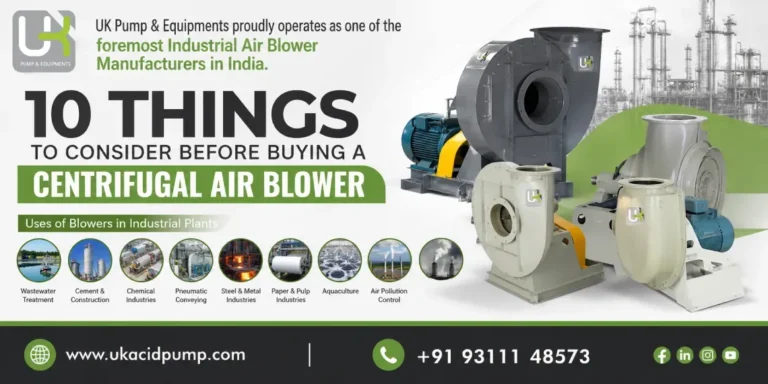
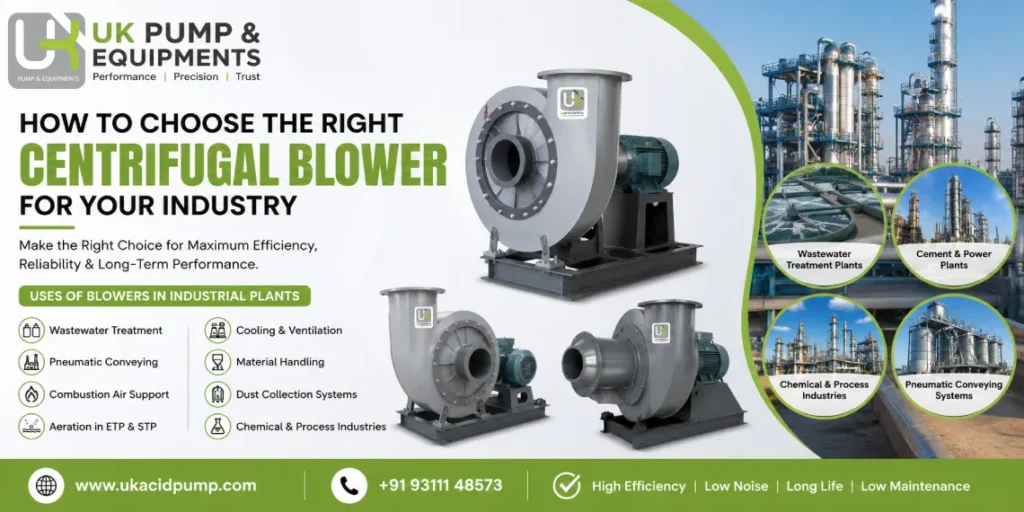
Selecting the right centrifugal blower isn’t just a technical checkbox — it directly affects your plant’s efficiency, energy costs, and equipment lifespan. With dozens of models, materials, and configurations available, choosing the wrong blower can lead to poor airflow, excessive noise, premature wear, or even complete system failure.
As one of the leading Industrial Air Blower Manufacturers in India, UK Pump & Equipments has put together this practical guide to help you understand exactly what to look for before you invest in a centrifugal blower for your operation.
What Is a Centrifugal Blower?
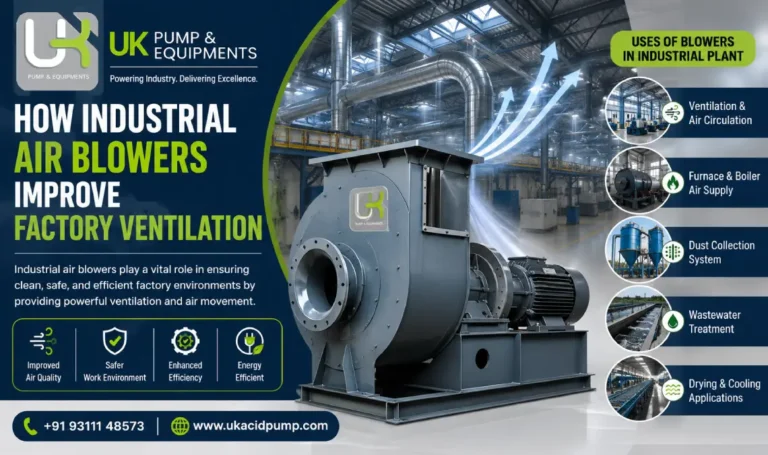
A centrifugal blower uses a rotating impeller to draw air in and accelerate it outward using centrifugal force, converting kinetic energy into pressure. Unlike axial fans, which move air in a straight line, centrifugal blowers change the direction of airflow by 90 degrees — making them ideal for applications that require higher pressure and controlled airflow, such as dust collection, pneumatic conveying, and combustion air supply.
Key Factors to Consider Before You Buy
1. Airflow Requirement (CFM)
Every application has a specific volume of air it needs moved per minute, measured in CFM (cubic feet per minute) or m³/hr. Undersizing this leads to inadequate performance, while oversizing wastes energy. Always calculate your required airflow based on the actual process — not just the blower’s maximum rated capacity.
2. Static Pressure Needs
Static pressure determines how well a blower can push air through ducts, filters, or resistance in the system. Applications like pneumatic conveying or long ducting runs need high pressure blowers, while simple ventilation tasks may only require a low-pressure unit. Matching pressure requirements to your ductwork and system resistance is critical for efficiency.
3. Blade Design
Centrifugal blowers typically come in three blade configurations:
- Forward curved blades — higher airflow at lower pressure, common in HVAC
- Backward curved blades — better efficiency and stability, ideal for industrial exhaust and process air
- Radial blades — built for heavy-duty, high-pressure, and material-handling applications with abrasive or particulate-laden air
Choosing the right blade type has a direct impact on efficiency, noise levels, and maintenance frequency.
4. Material of Construction
The material must match the environment and the nature of the air being handled:
- Mild Steel (MS) — cost-effective, suited for general industrial air
- Stainless Steel (SS) — necessary for corrosive, humid, or food-grade/pharma environments
- FRP (Fiberglass Reinforced Plastic) — ideal for chemical fume extraction and corrosive gas handling
5. Single-Stage vs Multi-Stage Design
Single-stage centrifugal blowers work well for moderate pressure needs, while multi-stage blowers are engineered for applications demanding significantly higher pressure in a compact footprint — common in pneumatic conveying and vacuum systems.
6. Motor Power and Drive Type
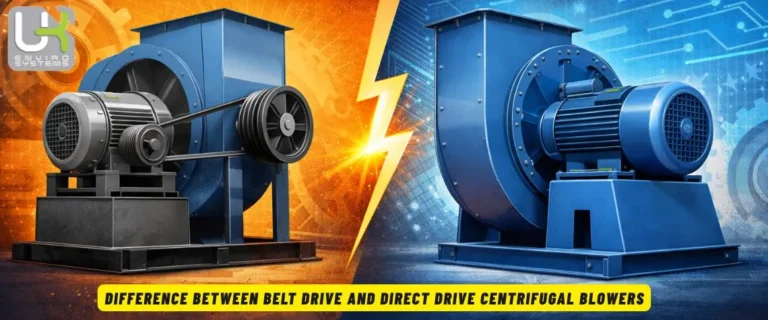
Direct-drive blowers are compact and efficient for lower-power applications, while belt-driven blowers offer more flexibility in adjusting speed and airflow — useful when process requirements may change over time.
7. Operating Environment
Temperature, humidity, dust load, and the presence of corrosive or explosive gases all influence blower selection. High-temperature applications (like furnace or boiler combustion air) require special impeller and casing materials rated for continuous heat exposure.
Choosing a Centrifugal Blower by Industry
| Industry | Application | Recommended Blower |
|---|---|---|
| Cement & Mining | Material handling, dust collection | Radial Blade (MS/SS) |
| Chemical & Pharma | Fume extraction | FRP / SS |
| Boiler & Furnace | Combustion air supply | Backward Curved |
| Textile | Ventilation & drying | Forward Curved |
| Food Processing | Cooling & conveying | SS Hygienic |
| Power Plants | Ash & flue gas handling | High-Pressure Radial |
Common Mistakes to Avoid
- Selecting based on horsepower alone instead of actual CFM and pressure requirements
- Ignoring duct resistance when calculating required static pressure
- Choosing the cheapest option without considering long-term energy consumption
- Overlooking maintenance access — a compact design can be costly if it complicates servicing
- Not accounting for future capacity expansion in the plant
Why Partner with UK Pump & Equipments
With deep expertise as a trusted Centrifugal Blower Manufacturer, UK Pump & Equipments designs and delivers blower solutions engineered around your actual process conditions — not generic specifications. Our team helps you evaluate airflow, pressure, material, and application needs so you get a blower that performs reliably for years, not just on paper.
Final Thoughts
The right centrifugal blower isn’t about picking the biggest or most powerful unit — it’s about matching CFM, pressure, material, and design precisely to your process. Getting this right upfront saves on energy costs, reduces downtime, and extends equipment life significantly.
Need help selecting the right centrifugal blower for your industry? Get in touch with UK Pump & Equipments for expert guidance and a solution built around your exact operational needs.
FAQs: Choosing the Right Centrifugal Blower
The terms are often used interchangeably, but generally, "blower" refers to units generating higher static pressure (used for ducted systems, conveying, or combustion air), while "fan" refers to units built for high airflow at lower pressure, like general ventilation.
CFM is calculated based on the volume of the space or process, air changes needed per hour, and any resistance from ducting or filters. It's best to have your process engineer or blower manufacturer calculate this using your actual system layout rather than estimating.
Not usually. Since blower selection depends on specific CFM, pressure, and material requirements, a unit sized for one process (like dust collection) may underperform or overconsume energy in another (like combustion air). Dedicated units per application typically deliver better efficiency.
With proper maintenance, a well-selected centrifugal blower can run efficiently for 10-15 years. Lifespan depends heavily on correct sizing, material suited to the operating environment, and regular bearing/impeller maintenance.
Common causes include impeller wear or buildup, duct leaks, clogged filters, worn bearings, or belt slippage in belt-driven units. Regular inspection helps catch these before they affect output significantly.
No. Horsepower alone doesn't determine performance — CFM and static pressure ratings matter more. A higher HP motor on an incorrectly sized blower wastes energy without improving actual airflow or pressure delivery.
FRP (Fiberglass Reinforced Plastic) or stainless steel are generally preferred for chemical and corrosive environments, since they resist degradation from fumes and moisture better than standard mild steel.
Yes. Routine checks on bearings, belts, impeller cleanliness, and vibration levels are essential. Neglecting maintenance is one of the leading causes of premature blower failure in industrial settings.
If your application needs moderate pressure (like general ventilation or exhaust), a single-stage blower is usually sufficient. Applications requiring very high pressure in a compact space — like pneumatic conveying or vacuum systems — typically need multi-stage units.
Yes. As a manufacturer, UK Pump & Equipments designs blowers based on your exact CFM, pressure, material, and environmental requirements rather than offering only off-the-shelf configurations.