Propeller Type Agitator Manufacturers
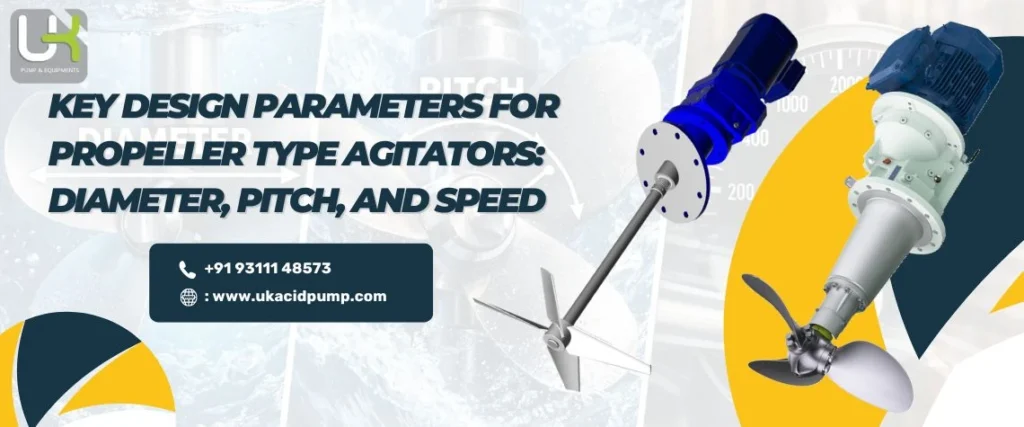
Selecting the right agitator is crucial for optimal process efficiency. For many applications, Propeller Type Agitator Manufacturers recommend their solutions for good reason. These mixers deliver reliable axial flow for a range of duties. However, their performance hinges on three core design parameters. Getting the diameter, pitch, and speed right determines success. At UK PUMP & EQUIPMENTS, we engineer agitators for precision. Therefore, we will explore these critical design elements in detail.
The Role of Propeller Agitators in Industrial Mixing
Propeller agitators are fundamental in many industries. They create strong axial flow patterns within a vessel. This flow moves liquid downward or upward in a defined column. Consequently, they are excellent for blending low-viscosity fluids. They also promote heat transfer and suspend light solids. As premier Agitator Mixer Manufacturers, we deploy them in chemical, water, and food processing. Their simplicity and effectiveness make them a popular choice.
The Triumvirate of Performance: Diameter, Pitch, and Speed
Three parameters govern a propeller’s performance. These are the impeller diameter, the blade pitch, and the rotational speed. Engineers must balance these factors carefully. This balance achieves the desired process outcome efficiently. Understanding their individual and combined effects is essential. It separates adequate mixing from exceptional process results.
Impeller Diameter: The Foundation of Flow
The propeller diameter directly influences the flow rate. Simply put, a larger diameter moves more fluid per revolution. It affects the swept volume and the pumping capacity of the agitator.
1. Diameter to Tank Ratio (D/T)
A key design rule is the D/T ratio. This is the impeller diameter divided by the tank diameter. For standard axial flow, a typical D/T ratio ranges from 0.2 to 0.5. A smaller ratio suits high-speed blending. Conversely, a larger ratio provides more bulk flow. Selecting the correct ratio ensures effective reach. It prevents stagnant zones in the vessel corners.
2. Impact on Power Draw
Diameter significantly impacts power consumption. Power draw relates to the diameter raised to the fifth power. Therefore, a small increase in diameter demands much more motor power. Engineers must consider this for energy efficiency. Proper sizing avoids an undersized or wasteful system.
Blade Pitch: Directing the Flow
Pitch refers to the angle of the propeller blades. It determines how aggressively the blade “screws” through the fluid. Think of it like the pitch on a boat or airplane propeller. It is a primary driver of the fluid’s discharge pattern and velocity.
1. Standard Pitch vs. Variable Pitch Designs
A “standard pitch” propeller often has a blade angle of 45 degrees. This provides a balanced mix of flow and shear. Many Industrial Propeller Type Agitators use this reliable design. “Variable pitch” blades change angle from hub to tip. This design can optimize flow efficiency further. It reduces wasteful recirculation and improves pumping effectiveness.
2. Pitch for Specific Process Duties
Pitch selection aligns with the process goal. A lower pitch angle generates higher shear with less flow. This can be useful for certain dispersion tasks. A higher pitch angle maximizes axial pumping for blending. For a Chemical Mixer Agitator, the correct pitch ensures uniform concentration. It prevents settling or stratification of reagents.
Rotational Speed: The Driver of Intensity
Rotational speed, measured in RPM, is the agitator’s engine. It directly controls the impeller’s tip speed and the fluid’s velocity. Speed determines the intensity of mixing and the power input.
1. Tip Speed and Its Implications
Tip speed is a critical derived parameter. We calculate it from diameter and RPM. It dictates the shear forces present in the mixture. For sensitive processes, tip speed must be limited. This protects delicate particles or biological cells. For other duties, high tip speed ensures rapid incorporation.
2. Speed for Blending vs. Suspension
Different tasks require different speed settings. Simple liquid blending may need only moderate RPM. Suspending solids requires sufficient velocity to lift particles. This often demands a higher rotational speed. Engineers must match the speed to the process fluid’s properties. Viscosity is a major factor here.
Integrating Parameters for Process Success
These parameters do not work in isolation. They interact dynamically within the mixing vessel. The combined effect defines the system’s performance.
The Power Number and Fluid Dynamics
Engineers use the Power Number (Np) for scale-up. This dimensionless number relates to the impeller geometry. Diameter, pitch, and speed all feed into its calculation. The Power Number helps predict power draw in different fluids. It is a vital tool for Agitator Mixer Manufacturers. It ensures consistent performance from lab to full scale.
Achieving the Desired Flow Pattern
The ultimate goal is a predictable flow pattern. The right parameter combination creates this. Diameter sets the flow scale. Pitch directs its angle and character. Speed determines its energy and reach. Together, they ensure full-tank circulation. This is non-negotiable for a reliable Industrial Agitator.
Application-Specific Design Considerations
General principles must adapt to real-world conditions. The process medium dictates final design choices.
Designing for Corrosive or Abrasive Services
In a Chemical Mixer Agitator, material compatibility is paramount. The design must accommodate the corrosion resistance needed. However, diameter and speed also affect component wear. Abrasive slurries demand robust designs and sometimes lower tip speeds. This minimizes erosion on the impeller blades.
Viscosity and Its Overriding Influence
Fluid viscosity dramatically changes mixing requirements. Propeller agitators excel in low to medium viscosity fluids. As viscosity increases, flow patterns can break down. This often requires a larger diameter or altered pitch. Sometimes, it necessitates a different impeller type altogether. Expert manufacturers guide this critical decision.
The Manufacturer's Role in Optimal Design
Partnering with an expert is the most important step. Theoretical design meets practical engineering here.
Beyond Standard Catalog Selection
True engineering partners do more than sell catalog items. They analyze your specific process. They consider fluid rheology, tank geometry, and desired outcome. Then, they calculate the optimal diameter, pitch, and speed. This consultative approach defines premier Propeller Type Agitator Manufacturers.
UK PUMP & EQUIPMENTS: Engineering Your Solution
At UK PUMP & EQUIPMENTS, we build more than agitators. We engineer mixing solutions. Our team calculates these design parameters meticulously. We ensure your Industrial Propeller Type Agitators deliver target performance. Our commitment to excellence guarantees robust and efficient operations. We transform core parameters into process reliability.
Conclusion: Precision in Design Drives Performance
In summary, diameter, pitch, and speed are interdependent keys. They unlock efficient and effective mixing in propeller agitators. Mastering their relationship is essential for any project. This knowledge ensures you select a mixer that fits your process perfectly. It avoids the high costs of under-performance or over-design. For engineers and plant managers, this understanding is powerful. It enables informed discussions with Agitator Mixer Manufacturers. Ultimately, precise design focus leads to superior process results, operational savings, and long-term asset value. Trust partners who delve deep into these details for your success.