Belt Drive vs Direct Drive Centrifugal Blowers
At UK Pump & Equipments, our expertise in robust industrial solutions includes a deep understanding of Direct Drive Centrifugal Blowers. These efficient systems are crucial for many applications. Equally important are their counterparts, belt drive centrifugal blowers. Selecting the wrong type can affect your entire operation. This guide will detail their core differences. We will explore design, performance, and ideal use cases. This knowledge ensures you invest in the perfect air movement technology.
Core Principles of Centrifugal Blower Operation
Centrifugal blowers move air using kinetic energy. An impeller rotates at high speed within a housing. Air enters the centre of this impeller. Then, spinning blades accelerate the air outward. This action creates centrifugal force. Consequently, pressure and velocity increase significantly. The housing then converts this velocity into stable, usable pressure. This process is common to all centrifugal blowers. The drive method is the critical differentiator.
The Critical Role of the Impeller
Impeller design dictates performance characteristics. Common types include backward-inclined and forward-curved designs. Each offers a unique pressure and flow relationship. Selecting the proper impeller is the first step. Next, you must choose the drive mechanism. This choice defines maintenance, efficiency, and control.
Understanding Direct Drive Centrifugal Blowers
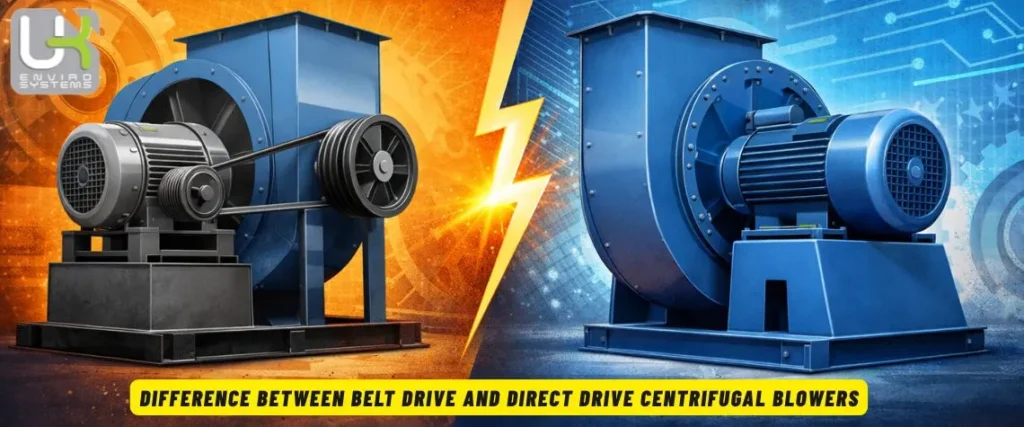
Direct Drive Centrifugal Blowers feature a simplified mechanical design. The blower’s impeller connects directly to the motor shaft. A secure coupling often makes this connection. This creates a single, unified rotating assembly. Therefore, the motor and impeller share the same rotational speed. No intermediate components transfer power. This direct connection offers distinct advantages.
Key Features of the Direct Drive System
The design minimizes moving parts. This integration reduces potential failure points. Alignment is permanent and precision-engineered at the factory. Consequently, mechanical power transfer is exceptionally efficient. Motor bearings typically support the impeller shaft directly. This compact design saves considerable space. It is a model of engineering simplicity.
Exploring Belt Drive Centrifugal Blowers
A Belt Drive Centrifugal Blower uses an indirect drive system. Here, separate motors and blower shafts operate. A poly-V belt connects pulleys on each shaft. The motor pulley drives the blower pulley. Thus, the motor speed and impeller speed can differ. This is achieved by varying the pulley sizes. The system offers inherent flexibility.
Components of the Belt Drive Assembly
The setup requires several key parts. These include two pulleys and a durable belt. An adjustable motor base maintains proper belt tension. Some systems also use an idler pulley for tensioning. This adjustability is a primary benefit. However, it introduces components that need regular attention.
Mechanical Design: A Fundamental Comparison
The core architectural difference dictates all other factors. This is the heart of the selection process.
Simplicity vs. Adjustability
- Direct drive champions simplicity. Its compact, integrated build is a key advantage. The motor and blower become one cohesive unit. This design reduces spatial footprint dramatically. Installation often involves mounting a single assembly. It is a straightforward approach.
- Belt drive systems prioritize adjustability. Their design incorporates deliberate separation. This separation allows for speed ratio changes. The physical setup is more complex initially. However, this complexity enables future modifications. You can alter performance without new hardware.
Performance and Efficiency Analysis
Operational output and energy use are vital concerns. Each system has a distinct profile.
Speed Control and Operational Flexibility
- Direct drive blowers typically run at fixed speeds. The impeller rotates at the motor’s synchronous RPM. To vary output, you need an electronic controller. A Variable Frequency Drive (VFD) adjusts motor speed. This adds cost but provides excellent control.
- Belt drive blowers offer mechanical speed control. You change the pulley ratio to alter impeller speed. This provides a cost-effective way to tune performance. One blower can serve multiple duty points. It is a highly adaptable solution.
Energy Transmission Efficiency
- Direct drive units excel in efficient power transfer. Energy loss between the motor and impeller is minimal. Efficiency often exceeds 95% at the drive point. This makes them superb for continuous, high-duty cycles.
- Belt drive systems have inherent transmission losses. Belt friction and flexibility cause these losses. Typical efficiency ranges from 90% to 94%. Proper tensioning is crucial to maintain this level. Worn belts can significantly reduce efficiency.
Maintenance and Longevity Considerations
Long-term reliability depends heavily on upkeep. The maintenance schedules differ greatly.
Routine Service Requirements
- Belt drive blowers require proactive maintenance. Belts wear, stretch, and require periodic replacement. Pulleys and bearings also need inspection and lubrication. Regular tension checks are essential to prevent slippage. This maintenance is usually simple and low-cost.
- Direct drive blowers need less frequent routine service. They have no wearable drive components. Sealed, lubricated-for-life bearings are common. Maintenance primarily involves checking motor health and cleaning. However, repairs can be more complex if needed.
System Longevity and Failure Modes
- Belt drive systems benefit from component isolation. The belt acts as a mechanical fuse. It can protect costly motors and impellers from shock loads. Replacing a belt is a quick, inexpensive repair. This can extend the overall system’s life.
- Direct drive blowers have coupled fates. A bearing failure or imbalance affects the entire unit. Stress on the impeller directly transfers to the motor. Repairs may require full disassembly. This can lead to higher downtime costs.
Cost Implications: Initial and Lifetime
Financial analysis must look beyond the purchase price. Total cost of ownership reveals the true picture.
Initial Capital Investment
- Belt drive blowers often have a lower upfront cost. The motors are standard and sometimes smaller. The blower unit itself can be less complex. This makes them attractive for tight initial budgets.
- Direct drive blowers may cost more initially. Integrated motor-blower assemblies require specialized engineering. High-precision balancing adds to manufacturing cost. The investment is in long-term efficiency and reduced maintenance.
Operational and Lifetime Costs
- Direct drive blowers often save money over time. Their higher efficiency reduces electrical consumption. Lower maintenance needs decrease labour and part costs. For continuous operation, savings accumulate quickly.
- Belt drive blowers have recurring consumable costs. Belt and bearing replacements are a periodic expense. Energy costs may be slightly higher due to transmission losses. However, their flexibility can prevent entire system replacements.
Noise and Vibration Profiles
The acoustic and vibrational output impacts the work environment.
Audible Noise Characteristics
- Belt drive systems can generate specific mechanical noises. These include belt whine and flutter sounds. Proper tensioning minimizes but does not eliminate this. The motor itself is often physically separated. This can sometimes reduce overall perceived motor noise.
- Direct drive units are often quieter mechanically. They lack belt-associated noise. However, any motor or impeller hum transmits directly. The integrated design can make motor noise more apparent. High-frequency motor sounds may be noticeable.
Vibration and Resonance
- Direct drive blowers require precise dynamic balancing. Any imbalance directly vibrates the entire housing. This vibration can transfer into the support structure. Installation on resilient mounts is often critical.
- Belt drive systems have inherent damping. The belt absorbs some vibration between motor and blower. This can isolate impulsive loads. However, misaligned pulleys can cause severe vibration issues.
Selecting the Right Blower for Your Application
Matching the technology to the task ensures optimal results. Consider these specific application guides.
Ideal Uses for Direct Drive Centrifugal Blowers
Choose direct drive for constant, unchanging duties. They excel in wastewater treatment aeration. Continuous industrial vacuum systems also benefit. Any process requiring fixed pressure and flow is ideal. Applications with limited maintenance access are also suitable. Their compact size benefits space-constrained plants.
Perfect Applications for Belt Drive Centrifugal Blowers
Select belt drive for variable or evolving processes. HVAC systems with seasonal load changes use them. Industrial processes requiring future adjustments are ideal. Applications prone to shock loads or debris benefit. Systems without VFD compatibility are also candidates. Their adjustability offers great long-term value.
The Expertise of Centrifugal Blower Manufacturers
Consulting experienced Centrifugal Blower Manufacturers is invaluable. Companies like UK Pump & Equipments provide essential guidance. We analyze your entire system’s needs. Our engineers consider your operational schedule and environment. We help you evaluate all trade-offs. This partnership prevents costly misapplication. We ensure your investment delivers decades of reliable service.
Technological Evolution in Blower Design
Both systems continue to advance. Modern Direct Drive Centrifugal Blowers often include integrated VFDs. This merges direct drive efficiency with speed control. Advanced magnetic bearings are eliminating wear points. Belt Drive Centrifugal Blowers now use synchronous belts. These belts reduce slippage and increase efficiency. Automatic tensioners also minimize maintenance needs.
Conclusion: An Informed Decision for Your Plant
Your choice impacts efficiency, cost, and reliability for years. There is no universally superior technology. There is only the optimal choice for your specific needs. Direct Drive Centrifugal Blowers offer efficiency and low maintenance. Belt Drive Centrifugal Blowers provide flexibility and adaptability. Consider your duty cycle, maintenance team, and total budget. Partner with a knowledgeable supplier to review all factors. At UK Pump & Equipments, we help you navigate this critical decision. We ensure your selected blower becomes a reliable asset. This commitment supports our mission to deliver top-quality industrial solutions worldwide.